
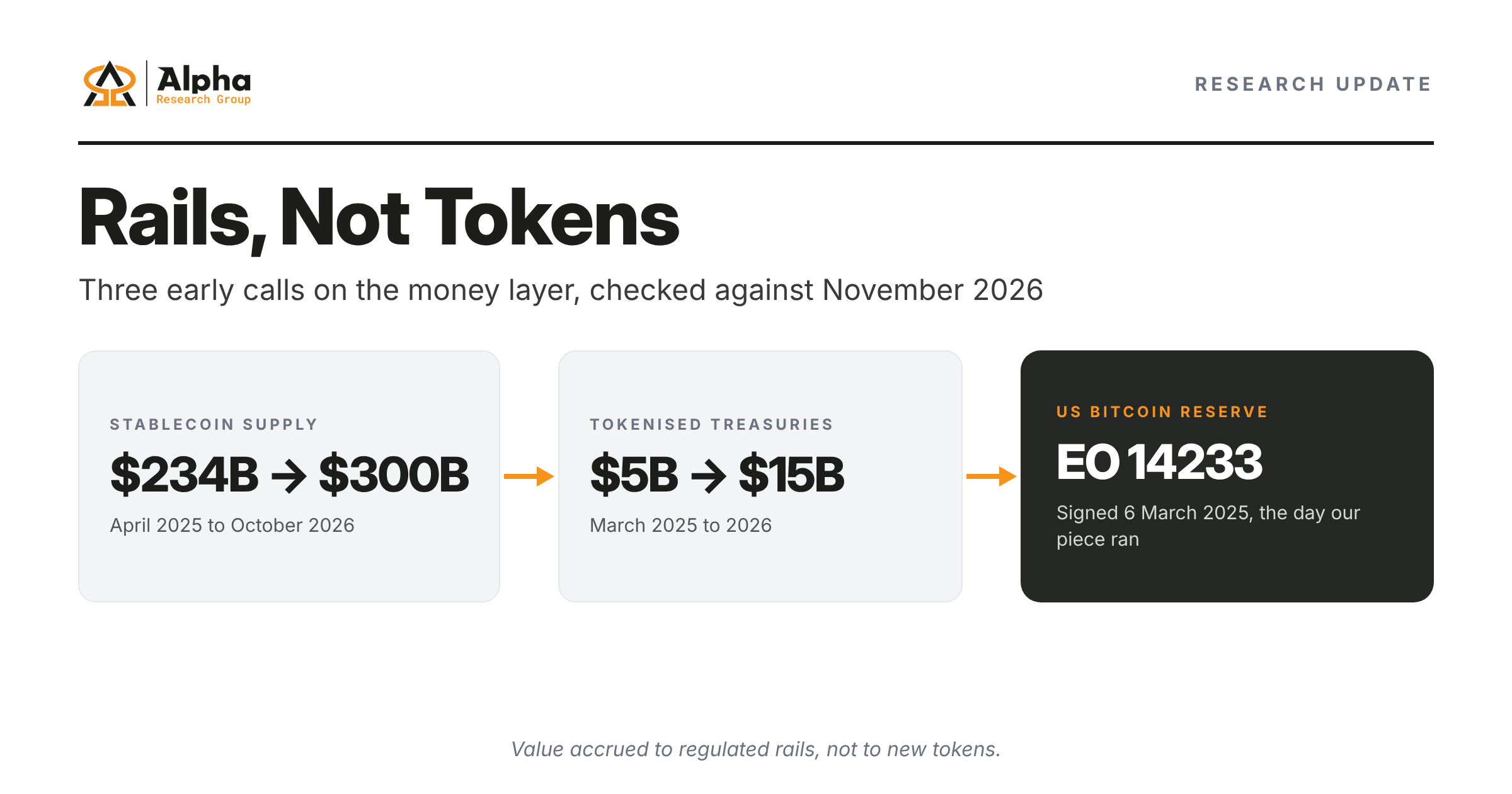
In March and April 2025, Alpha Research Group published three pieces on LinkedIn about the money layer of crypto: a scenario for a US strategic bitcoin reserve (6 March), a model for funding companies from yield rather than principal (20 March), and a critique of stablecoins with an alternative peg design (9 April). This post consolidates them into one, checks each call against what has happened since, and drops what no longer belongs.
The short version: the policy call landed almost to the day, the stablecoin headline did not, and the funding model was right about the rails and wrong about the rates. Across all three, the value has accrued to regulated settlement infrastructure rather than to new tokens, which is where our thesis has pointed since.
1. Strategic reserves: the call that landed
Our 6 March 2025 piece asked what would happen if the United States held a strategic reserve of bitcoin, with smaller allocations to other layer-one assets, while the SEC eased its posture, crypto ETFs multiplied and large banks moved into digital assets.
That evening, the President signed Executive Order 14233, establishing a Strategic Bitcoin Reserve and a separate US Digital Asset Stockpile. The detail matters. The reserve is funded only with bitcoin already forfeited to the government, the order says that bitcoin will not be sold, and any new acquisition must be budget neutral. Other assets sit in the stockpile, which will not be added to. In August 2025 the Treasury Secretary said the government would not be buying, and as of late 2026 no audited total has been published. Estimates of federal holdings range widely.
The rest of the scenario largely played out:
The SEC eased. It dismissed its cases against Coinbase and Binance, and in September 2025 approved generic listing standards for commodity-based ETPs. The first US spot Solana ETF launched on 28 October 2025 and spot XRP followed in November.
Banks moved in. The OCC confirmed in March and May 2025 that national banks can provide crypto custody and stablecoin services, granted conditional trust charters to several crypto firms in December 2025, and JPMorgan put a deposit token live on a public chain for institutional clients.
States experimented. New Hampshire passed the first state reserve law in May 2025, and Texas made a small first purchase in November 2025.
Enforcement capacity fell, though not by half. IRS staffing dropped by about a quarter by mid-2025.
The risks we named also showed up. Custody failed at scale when about $1.5B was stolen from Bybit in February 2025, and leverage unwound violently on 10 October 2025, when more than $19B in positions were liquidated in a day. Legislation has been slower than the executive branch. The CLARITY market-structure bill passed the House in July 2025 but failed a 49 to 50 Senate cloture vote in September 2026, and bills that would buy bitcoin for the reserve have not advanced.
2. Stablecoins: wrong headline, right risk
Our 9 April 2025 piece was titled “Stablecoins Are Broken.” As a market call, that was wrong. Stablecoin supply has grown from roughly $234B in April 2025 to about $300B in October 2026, and the GENIUS Act, signed in July 2025, gave US payment stablecoins a federal framework built on full reserves, monthly disclosure and priority for holders in insolvency.
The risk we described is real, and it is now written into the design. Collateral-backed stablecoins depend on an issuer that can freeze balances. Between 2023 and 2025, Tether froze about $3.3B across more than 7,000 addresses and Circle about $109M. That is a feature for compliance and a dependency for everyone else, and it is why we treat issuer and custody risk as part of diligence on any company building on these rails.
Synthetic and algorithmic designs remain fragile under stress. Ethena’s USDe briefly traded at $0.65 on one exchange during the October 2025 liquidation while holding near a dollar on-chain, and Stream Finance’s xUSD collapsed after a loss the following month.
The alternative we proposed, a peg to purchasing power through merchant-honoured units, has not found traction anywhere we can measure. The lesson we take is narrower than the original piece: reward units with no cash value and a fixed earn rate are a sound way to build loyalty, but they are a product feature, not a replacement for a dollar settlement asset.
3. Funding from yield: right rails, wrong rates
Our 20 March 2025 piece described principal-preserved protocol funding: investor capital held in a multisignature wallet, deployed into regulated yield, with the operating company drawing only the yield. The rails for this now exist in a way they did not then. Tokenised US Treasuries grew from about $5B in March 2025 to about $15B in 2026, permissioned lending markets such as Aave Horizon are live, and bitcoin-backed on-chain loans passed $1B originated through Coinbase and Morpho by October 2025.
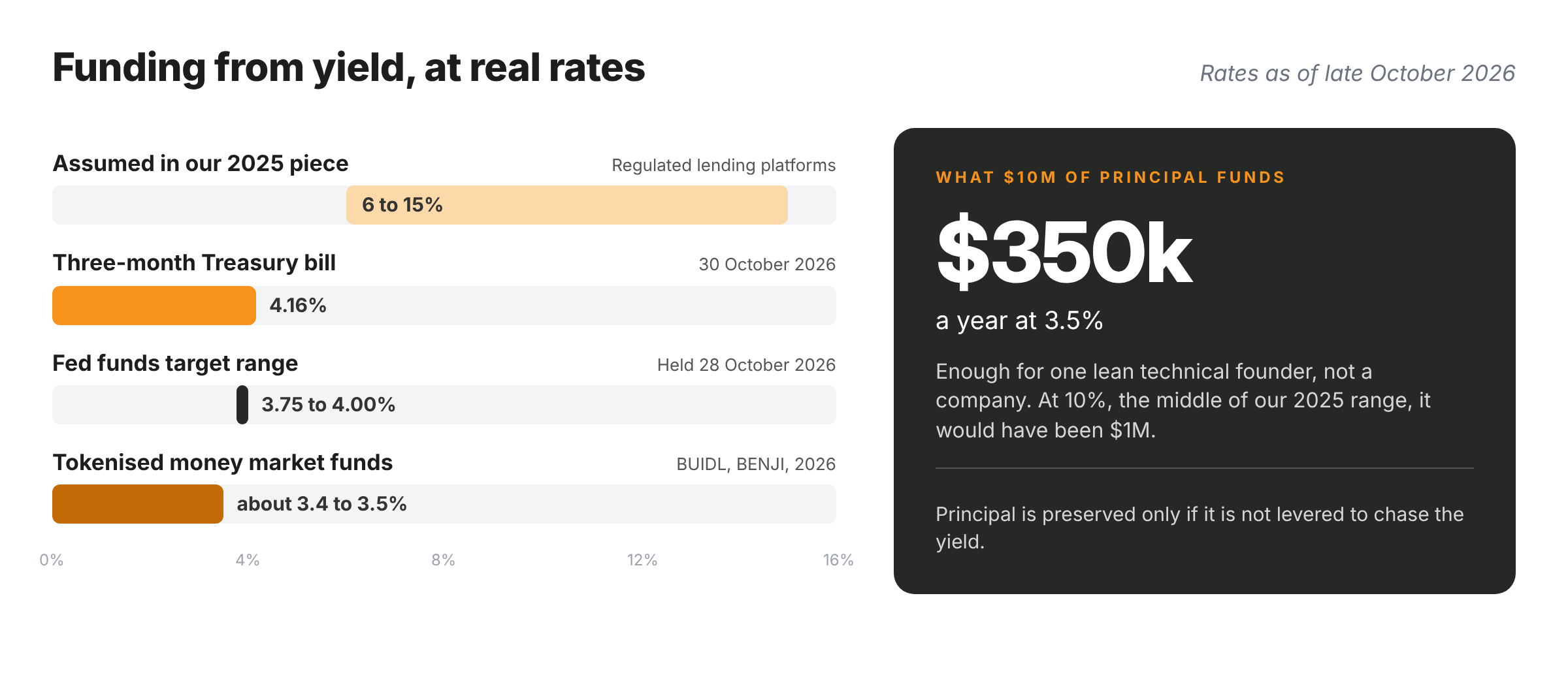
The rates did not hold. The original piece cited 6 to 15% from regulated platforms. Today the Fed funds range is 3.75 to 4.00%, three-month bills yield about 4.2%, and the largest tokenised money market funds pay around 3.4 to 3.5%. The GENIUS Act also bars payment stablecoin issuers from paying holders interest or yield. At those rates, $10M of principal funds roughly $350k a year of operations: a lean runway for a single technical founder, not a company.
The other lesson came from the companies that tried to make principal work harder. Strategy, the largest corporate bitcoin holder, saw its premium to net asset value briefly disappear in June 2026 and sold bitcoin below its average cost that summer to meet obligations. Principal is only preserved if it is not levered to fund the yield.
What held up, and what didn’t
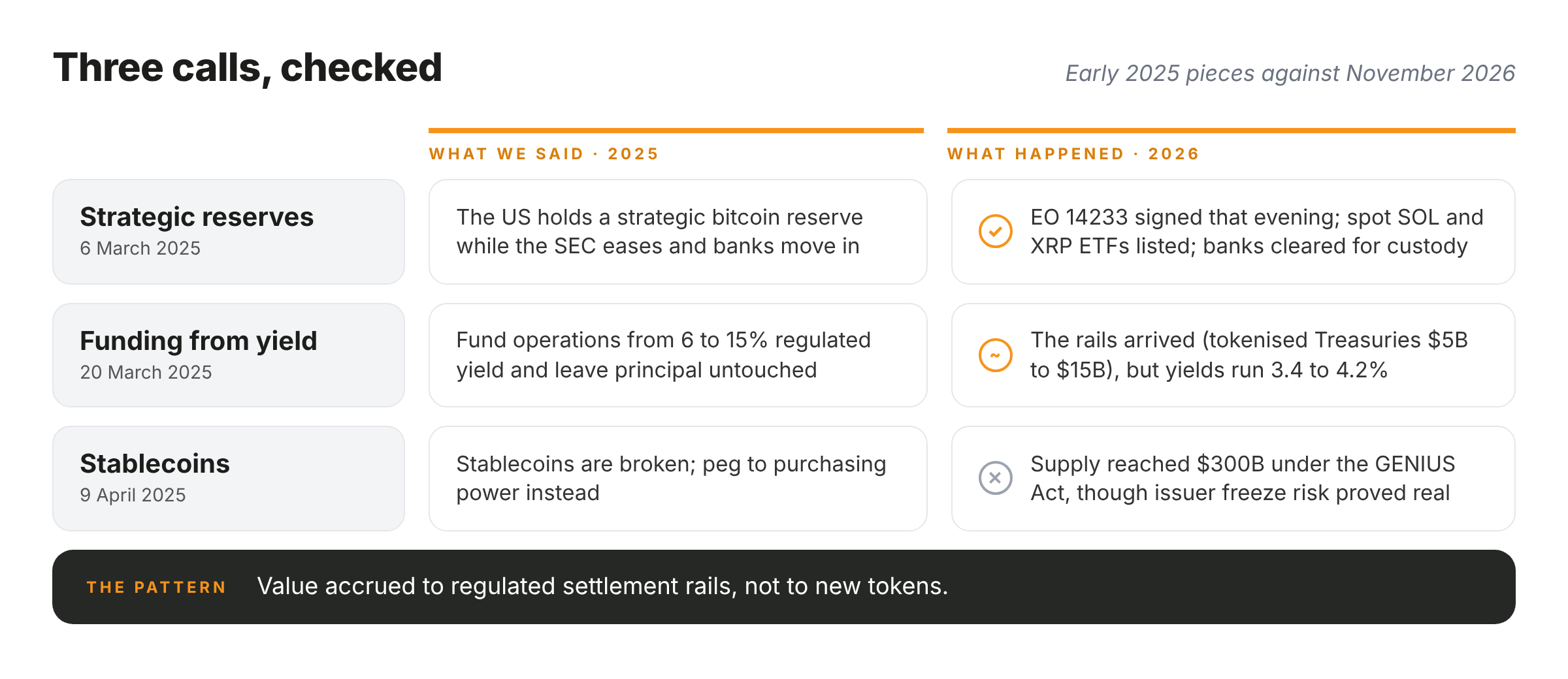
Held up: a US strategic bitcoin reserve (EO 14233, signed the day our piece ran); an easing SEC and spot altcoin ETFs; banks entering custody and tokenised deposits; custody and leverage as the main risks; issuer freezes as the core stablecoin dependency; regulated on-chain yield rails.
Partly: allocations to other layer-one assets exist only as forfeited holdings in a stockpile; IRS capacity fell by a quarter, not half; banks issued deposit tokens rather than public stablecoins.
Did not: “stablecoins are broken” as a market call; adoption of a purchasing-power peg; 6 to 15% regulated yields.
Rails, not tokens
The pattern across all three pieces is the one we invest behind. The durable value of the last eighteen months accrued to settlement infrastructure: regulated stablecoins, tokenised Treasuries, bank custody and deposit tokens, and the compliance and security layers around them. New tokens with novel pegs did not capture it. We set out that positioning in The On-Chain Future Has Arrived, and the gap it still leaves for large holders, who operate without the wealth-management infrastructure equity holders take for granted, in The Founder Problem.
Our settlement thesis covers real-world asset tokenisation and private payment rails that run on infrastructure already in place. The questions we ask of founders in this area are the ones this review surfaced: who can freeze your users’ funds, what happens to your yield assumptions at 4% instead of 10%, and what still works when leverage unwinds in a day. More on how we invest is in The Genesis Fund.
Originally published on LinkedIn: Strategic Bitcoin (and L1 Crypto) Reserves in a Deregulated U.S. (6 March 2025); Principal-Preserved Protocol Funding (P3F): A New Approach to Blockchain Investment (20 March 2025); Stablecoins Are Broken: Introducing the Purchasing Power Peg (9 April 2025).
Sources: White House fact sheet on EO 14233; The Block; SEC press and litigation releases; OCC; Axios; Bond Buyer; CPA Practice Advisor (TIGTA data); FBI IC3; CoinGlass via Daily Hodl; The Defiant; DefiLlama via Bitcoin.com; GENIUS Act via UC Santa Barbara Presidency Project and Congressional Research Service; AMLBot; 21Shares; ForkLog; rwa.xyz via CoinDesk and Bitcoin.com; Federal Reserve; Stablecoin Insider; Forbes. Figures as of the dates linked.
This post is for informational purposes only and does not constitute investment advice, an offer to sell or a solicitation to purchase securities.