
Between February and April 2025, Alpha Research Group published three pieces on LinkedIn about privacy, zero-knowledge proofs and blockchain as a trust layer for AI: Blockchain: The Foundation of Truth in an AI-Powered World (20 February), Preserving Privacy and Free Expression with Blockchain and Zero-Knowledge Proofs (13 March) and Privacy by Design (3 April). This post consolidates them, updates the evidence to November 2026, and drops what no longer belongs.
The core argument has held. As AI makes convincing fakes cheap, the scarce thing is proof: that a person is real, that a claim is true, that a piece of content came from where it says it did. What has changed is the route. Proof is going mainstream through selective disclosure and signed provenance, ledgers are proving most useful as anchors rather than as the whole answer, and the law has drawn a much sharper line between privacy and anonymity than we drew in 2025.
1. The problem got bigger
The FBI’s Internet Crime Complaint Center recorded $893M in losses across more than 22,000 complaints it flagged as AI-related in 2025. In May 2025 it warned that AI-generated voice messages were being used to impersonate senior US officials. The reference case remains the engineering firm Arup, which lost about US$25M after a video call in which every other participant was a deepfake.
The response so far has been to ask people for more of their identity, more often. The UK’s Online Safety Act age checks took effect on 25 July 2025, and one VPN provider reported UK sign-ups up more than 1,400% within days. Every check that collects a document or a face scan creates another store of personal data to breach. That is the gap zero-knowledge proofs were built to close.
2. Prove it without revealing it
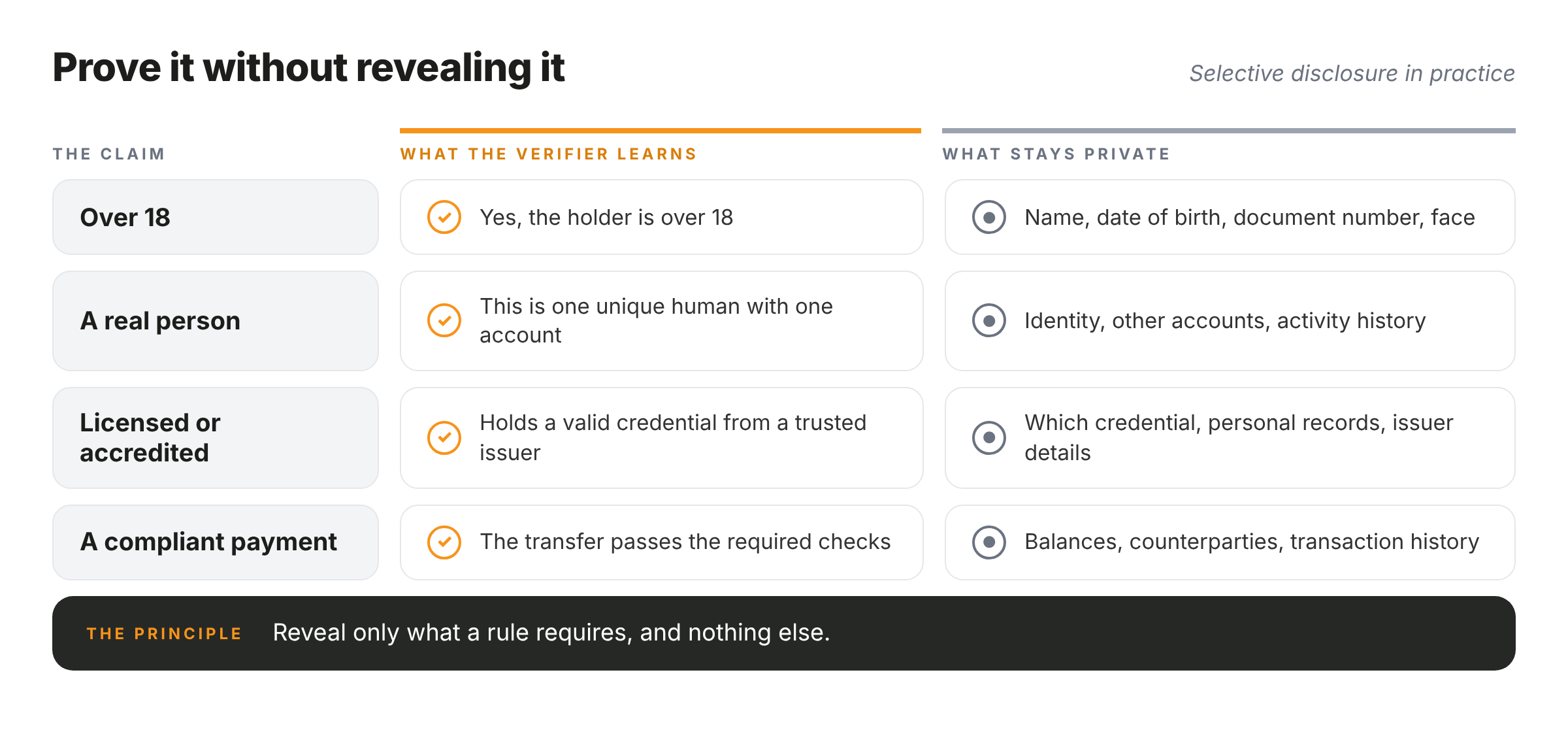
A zero-knowledge proof lets one party prove a statement is true without revealing why it is true. Our March 2025 piece used the obvious example: proving you are over 18 without disclosing your date of birth. Eighteen months later, that example is shipping.
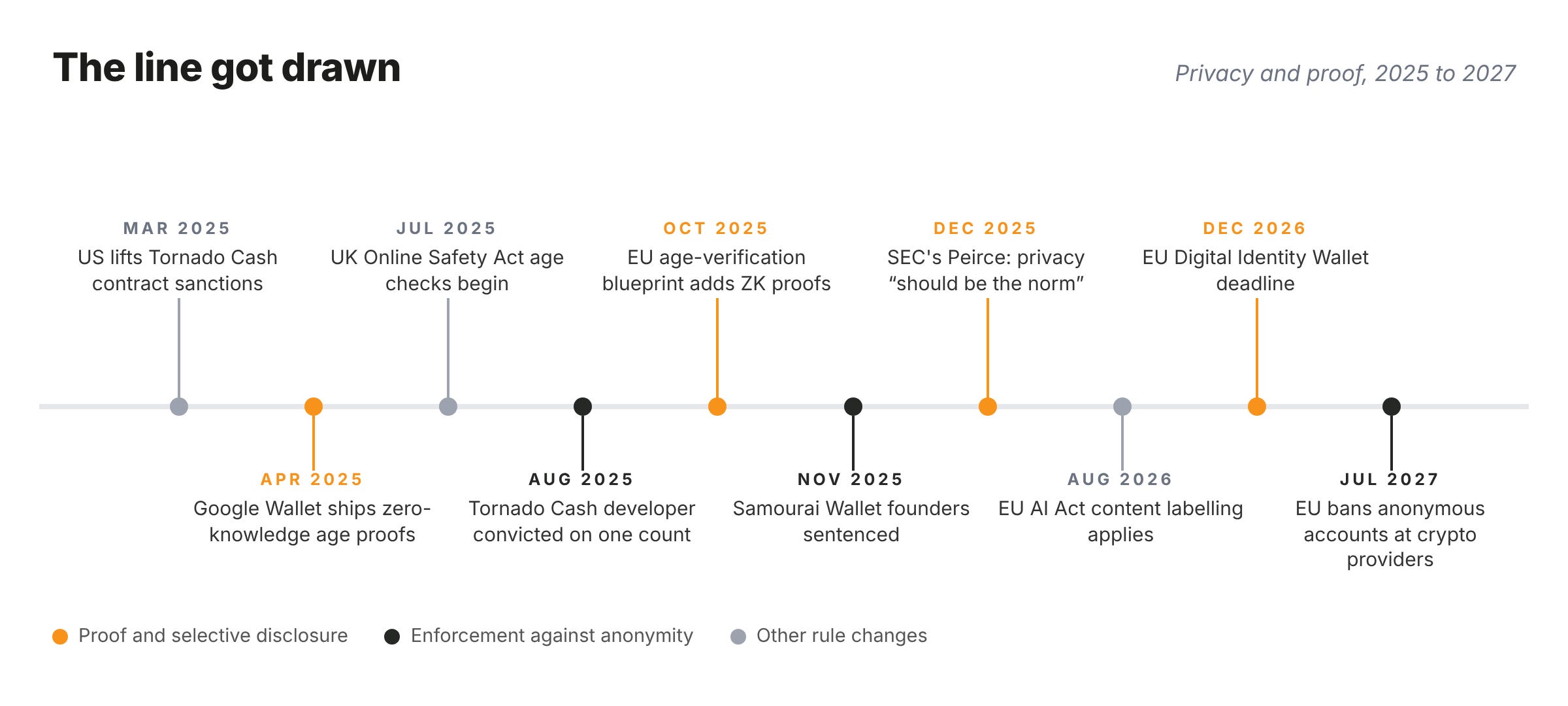
Google added zero-knowledge age proofs to Google Wallet in April 2025 and open-sourced its proof libraries in July 2025.
The European Commission’s age-verification blueprint added zero-knowledge proofs in its second version in October 2025 and is being piloted in Denmark, France, Greece, Italy and Spain. The wider EU Digital Identity Wallet is due by the end of 2026, though only a handful of member states were live in production by late October.
Performance stopped being the objection. Our 2025 piece listed computational cost as a challenge. In November 2025 Succinct reported proving 99.7% of Ethereum blocks in under 12 seconds on 16 consumer GPUs, and the Ethereum Foundation has made privacy a core workstream.
Regulators have started to say it out loud. SEC Commissioner Hester Peirce said in December 2025 that “protecting one’s privacy should be the norm, not an indicator of criminal intent”, and a March 2026 US Treasury report to Congress pointed to zero-knowledge proofs as a compliance tool.
The same pattern extends beyond age. A user can prove they are human, hold one account, carry a licence or meet a credit threshold, and reveal nothing else. That is the version of privacy that institutions can adopt, and it is the version we expect to scale.
3. Provenance: what is real, and where ledgers fit
Our February 2025 piece argued that blockchain’s append-only record would become the foundation for telling human from machine content. The need was right. The mainstream answer has mostly been signed metadata and watermarks, with ledgers playing a narrower role.
The law now requires labelling. Article 50 of the EU AI Act, which requires AI-generated content to be marked and disclosed, has applied since 2 August 2026. The EU’s 2026 omnibus delayed other AI Act deadlines but not this one.
Devices sign content at capture. Google’s Pixel 10 attaches Content Credentials to every photo its camera takes, and the Content Authenticity Initiative passed 6,000 members in early 2026.
Watermarks run at scale. Google had marked more than 10 billion pieces of content with SynthID by May 2025.
Ledgers are anchoring identity. On-chain attestations are real but concentrated: more than 3.6M on Base alone, a large share of them identity verifications.
Training-data provenance is the open gap. The EU requires providers of general-purpose models to publish a summary of their training content, but a summary is a disclosure, not a proof. Verifiable records of what a model was trained on, and when, remain largely unbuilt, and this is where an immutable, timestamped record still adds something signed metadata cannot.
4. Privacy is not the same as anonymity
Pseudonymity has protected new ideas while they were fragile. Thomas Paine’s Common Sense was published anonymously in January 1776, the Federalist Papers appeared under the name Publius, and Satoshi Nakamoto announced Bitcoin to a cryptography mailing list in October 2008 without a real name. The US Supreme Court put it plainly in 1995: “Anonymity is a shield from the tyranny of the majority.”
Since our April 2025 piece, the law has drawn the line between protecting identity and evading oversight much more firmly, in both directions:
Code itself was not the target. The US Treasury lifted sanctions on the Tornado Cash smart contracts in March 2025 after a federal appeals court held that immutable code is not property that can be sanctioned.
Operating businesses were. Tornado Cash developer Roman Storm was convicted in August 2025 of conspiring to operate an unlicensed money-transmitting business, with the remaining charges set for retrial in 2027. The founders of Samourai Wallet pleaded guilty and were sentenced to five and four years in November 2025.
Europe is closing anonymous accounts. From 10 July 2027, the EU Anti-Money Laundering Regulation bars crypto-asset service providers from offering anonymous accounts or handling anonymity-enhancing coins.
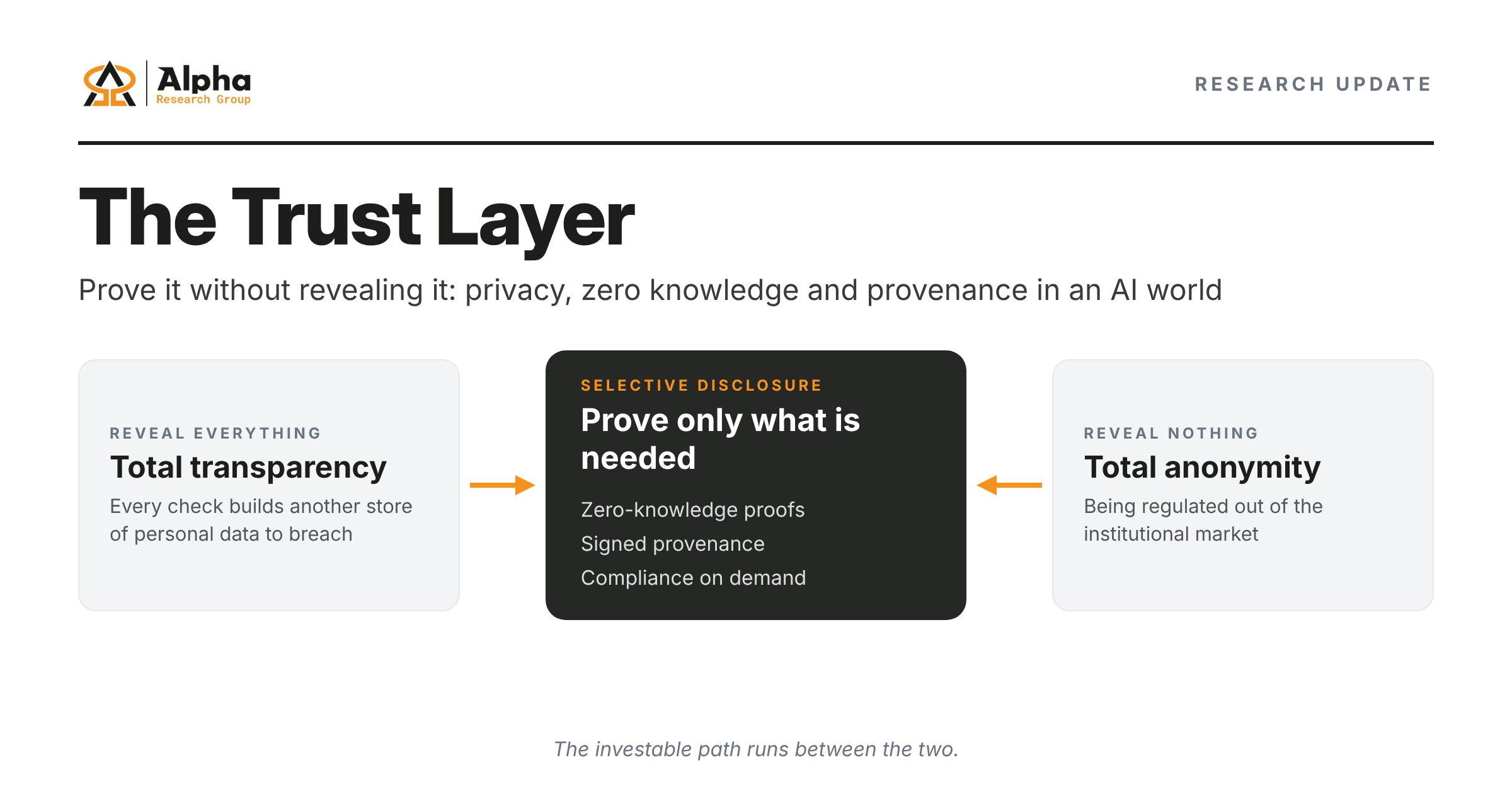
Our conclusion is narrower and more useful than the 2025 one. Privacy that can prove compliance when it must, by revealing only what a rule requires, is becoming the norm. Tools whose value is that nothing can ever be proven are being regulated out of the institutional market.
What held up, and what didn’t
Held up: AI fakes eroding trust; zero-knowledge proofs reaching mainstream products; zero-knowledge proving becoming fast enough to use at scale; pseudonymity as a protection for new ideas; legal risk for privacy tools.
Partly: content attestation became essential, but through signed metadata and watermarks with ledgers as anchors; training-data provenance is mandated as a summary, not a proof; permissionless AI access found real revenue but concentrated ownership.
Did not: our expectation that a light-touch enforcement environment would favour anonymity tools. US sanctions eased, but prosecutions continued, and the EU and UK tightened.
What we back
Our blockchain thesis includes private payment rails: systems that give users transaction privacy while proving compliance on demand. The same design principle runs through the trust layer more broadly: selective disclosure for identity, provenance and attestation for AI content and training data, and validation of the data AI systems depend on. The questions we ask founders here are simple. What exactly does your system prove, to whom, and what does it never have to reveal? As rules fragment across jurisdictions, a theme we covered in Washington’s AI War, proof that can satisfy more than one regulator at once becomes more valuable, not less.
More on how we invest is in The Genesis Fund.
Originally published on LinkedIn: Blockchain: The Foundation of Truth in an AI-Powered World (20 February 2025); Preserving Privacy and Free Expression with Blockchain and Zero-Knowledge Proofs (13 March 2025); Privacy by Design: Why Builders Like Satoshi Needed Anonymity and OpSec to Innovate Safely (3 April 2025).
Sources: FBI IC3 2025 Annual Report; Google; European Commission; SEC; US Treasury; US Department of Justice; IRS Criminal Investigation; National Archives (Founders Online); FEC; and the publications linked in the text. Figures as of the dates linked.
This post is for informational purposes only and does not constitute legal or investment advice, an offer to sell or a solicitation to purchase securities.