
On 27 February 2025, Alpha Research Group published two pieces on LinkedIn: a practical guide to the tool stack a solo technical founder could launch on, and the case for an incubator built around technical solopreneurs rather than conventional teams. This post consolidates them, checks both against November 2026, and describes how the model works today.
The short version: the solo founder thesis has held up better than almost anything else we wrote that year. The stack we published has not. It was built around cloud credits and SaaS tools, and it missed the change that now sits at the centre of every solo build: AI coding agents.
1. The founders moved first
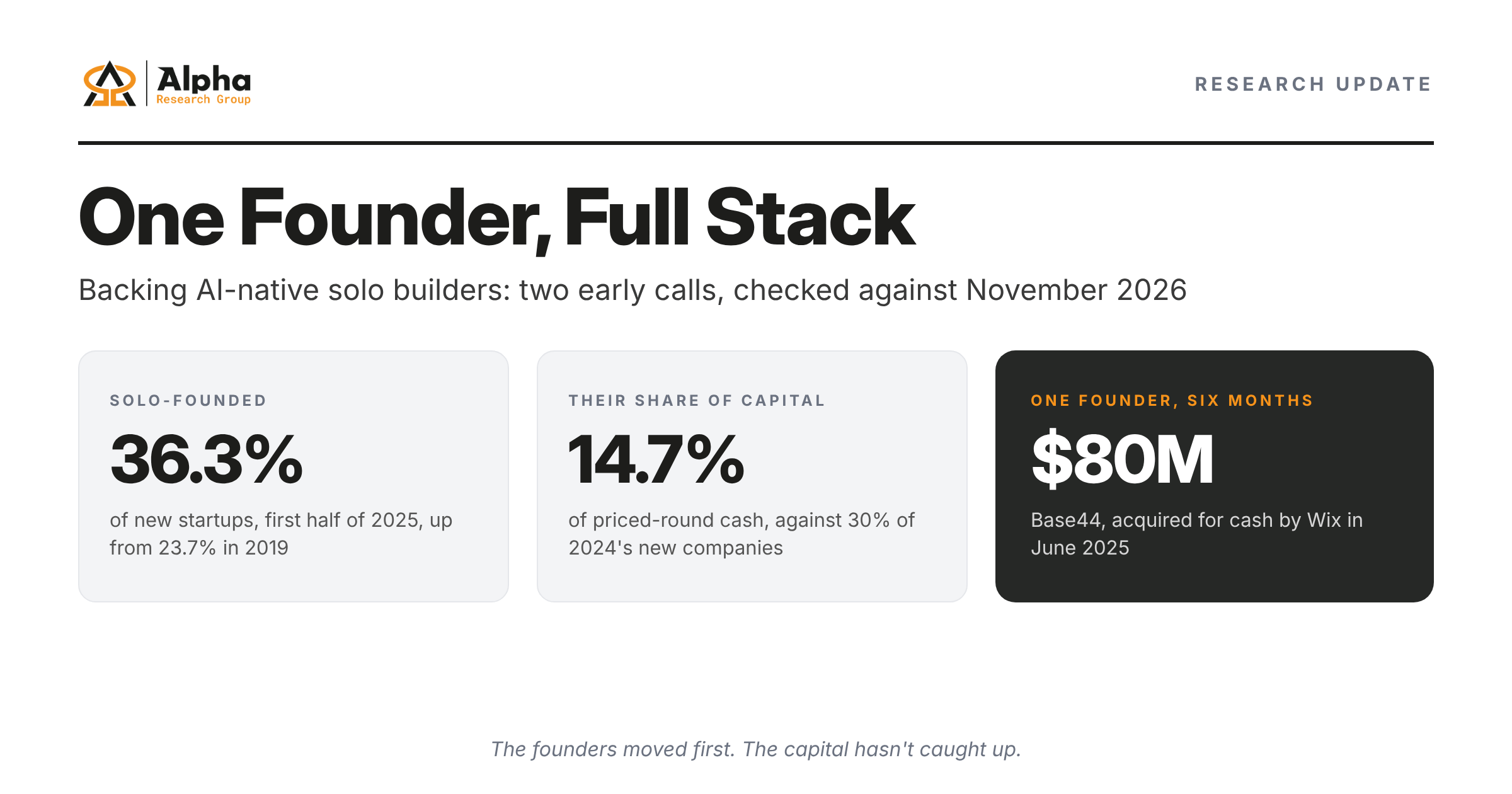
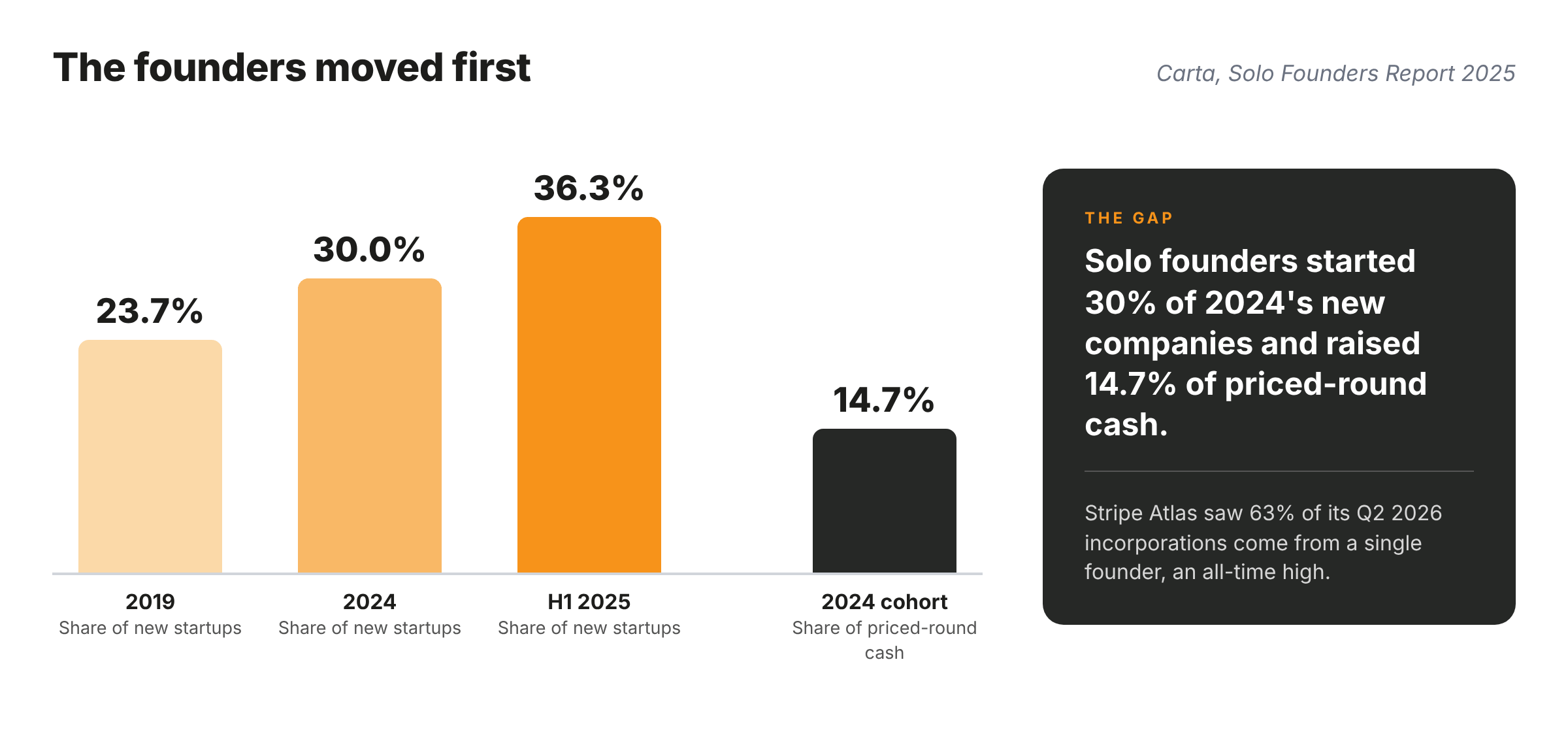
Carta’s Solo Founders Report, published in December 2025, found that solo founders started 23.7% of new startups in 2019 and 36.3% in the first half of 2025. Stripe sees the same shift earlier in a company’s life: in the second quarter of 2026, 63% of the companies incorporated through Stripe Atlas had a single founder, an all-time high. In March 2025, a quarter of Y Combinator’s winter batch reported that 95% of their code was AI-generated.
Very small teams are now building very large businesses:
Base44, built by one founder, was acquired by Wix for $80M in cash six months after launch.
Lovable passed $400M in annual recurring revenue with 146 people in early 2026.
Gamma reached $100M in annual recurring revenue, profitably, with about 50 in November 2025.
Anthropic’s chief executive predicted in May 2025 that the first one-person billion-dollar company would appear in 2026. As of late October, none has been verified. The direction is clear even if the headline milestone has not arrived.
2. The capital has not caught up
The same Carta report found that solo founders started 30% of 2024’s new companies but received just 14.7% of the cash raised in priced rounds. That gap is the opportunity we described in 2025, and it is still open. Most venture processes are built to underwrite teams, and a single technical founder with an AI-native build reads as key-person risk before it reads as capital efficiency.
The gap also shows up in a less obvious place. The startup credit programmes our 2025 stack leaned on have largely moved behind investors. Microsoft restructured its startup programme in July 2025: a self-serve founder now starts with $1,000 in Azure credits plus $4,000 after verification, while larger packages require an investor referral. AWS, Google Cloud and Anthropic all offer their largest credit tiers through partner investors or to venture-backed companies. A solo founder without an institutional relationship now pays more to start than one with it.
3. The stack, rebuilt around agents
Much of the 2025 stack still stands. Vercel, GitHub, Sentry, PostHog and Linear remain the defaults for good reasons, and Figma went public in July 2025. What changed is the centre of gravity. AI coding agents went from a feature to the core of the build: Anthropic reported Claude Code at a run-rate above $2.5B in February 2026, Cursor passed $1B in annualised revenue in November 2025, and OpenAI’s Codex reported more than 5M weekly users by June 2026.
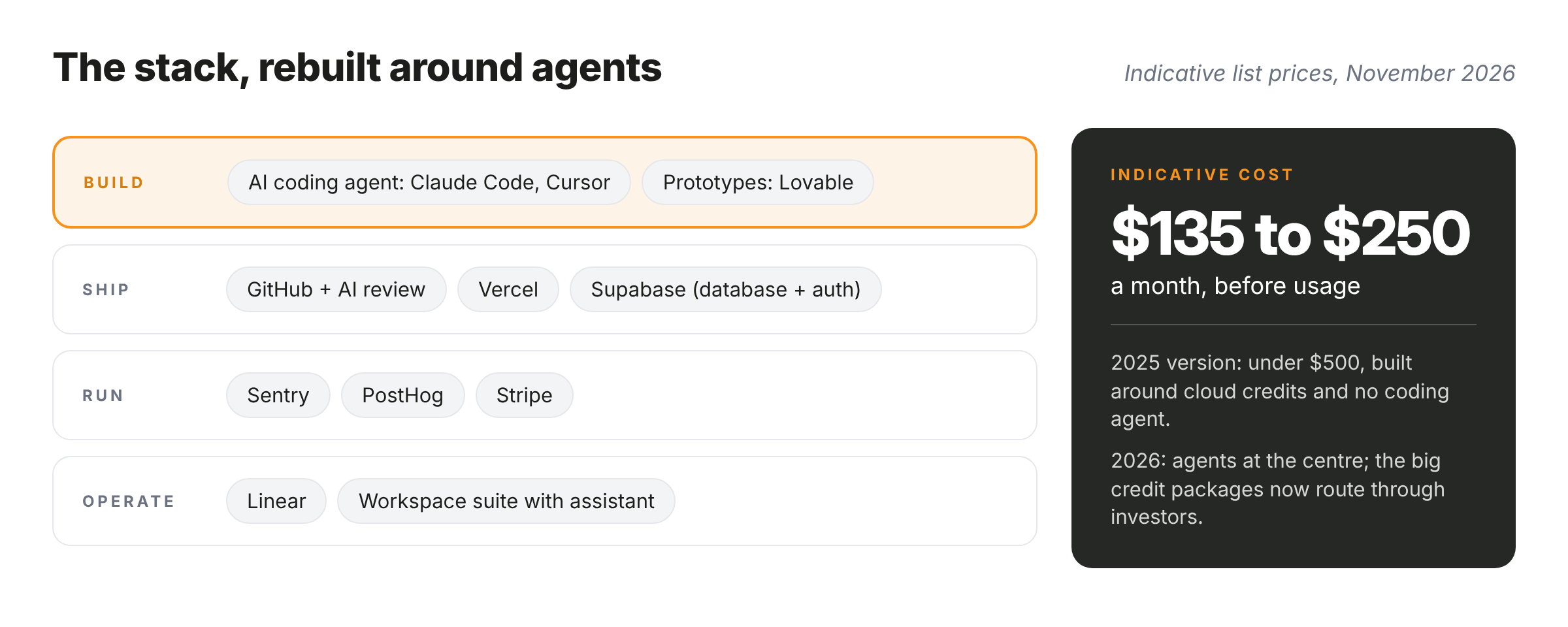
The 2026 version of the stack looks like this:
Build: an AI coding agent such as Claude Code or Cursor, with an app builder such as Lovable for fast prototypes.
Ship: GitHub with an AI reviewer, Vercel for hosting, and Supabase for the database and authentication in one place.
Run: Sentry for errors, PostHog for product analytics, and Stripe for payments.
Operate: Linear for issues and a productivity suite with an assistant built in.
At list prices, that runs at roughly $135 to $250 a month before usage. Our 2025 piece said under $500, so the cost call held, but for a different reason: the tools got cheaper and more capable, not the credits more generous. We went further into how solo builders get that leverage in The Solopreneur’s Edge, written jointly with AI².
4. How we work with solo founders now
Our 2025 piece framed an incubator for solopreneurs as an alternative to venture capital. Twenty months on, we see it as the stage before it. The ARG Solopreneur Venture Framework exists to get a technical solo founder to the point where conventional investors can underwrite them, and then to put them in front of those investors.
Selection is merit-based and global, in small cohorts, weighted toward demonstrated technical capability and fit with our three areas: blockchain settlement, baseload power and surgical AI.
The build is agent-first from day one, with security and architecture reviewed before the first enterprise customer asks, which is where solo builds most often stall.
Access covers the partner credits, programmes and introductions that now route through investors, drawing on our partners across UK, EU and US incubators and accelerators and the startup competitions we sponsor and judge.
The bridge connects founders with US venture capital and with co-investors in the UK and EU, alongside technical due diligence for the investors on the other side.
The first company through the framework was Soulbound Security, which launched in 2025 and operates independently of the firm.
What held up, and what didn’t
Held up: solo founders rising as a share of new companies; venture capital under-serving them; global, merit-based selection; very small teams building large businesses; the core developer tools in our 2025 stack; a full stack for well under $500 a month.
Partly: our “80 to 90% faster setup” claim was directionally right but never measured; some of our specific choices for authentication and AI tooling were overtaken by bundled platforms.
Did not: cloud credits as the founder’s “secret weapon,” now mostly gated behind investors; a stack built without AI coding agents, which became its core within months; incubation as an alternative to venture capital rather than the step before it.
What we back
We back technical founders, very often solo, building infrastructure in our three areas. The questions we ask are about the founder more than the headcount: can this person build the whole thing, secure it, and sell it, and what would they do with the first hire if they made one? Why we build in these three areas rather than chase hyperscale AI is set out in Beyond the AI Bubble. More on how we invest is in The Genesis Fund.
Originally published on LinkedIn: The Ultimate SaaS Startup Stack: A Solopreneur’s Guide to Rapid Launch (27 February 2025); Revolutionizing Tech: A Blockchain and AI Incubator’s Vision for the Future (27 February 2025).
Sources: Carta Solo Founders Report 2025; Stripe; TechCrunch; Business Wire; Startup Fortune; Microsoft Learn; AWS; Google Cloud; Figma; Anthropic; Constellation Research. Prices are indicative list prices from vendor pricing pages in November 2026 and change often. Figures as of the dates linked.
This post is for informational purposes only and does not constitute investment advice, an offer to sell or a solicitation to purchase securities.