

The financial press reports Deutsche Bank is implementing hedging strategies on its multi-billion dollar AI data Beyond the Bubble: Why Smart Capital is Diversifying into Anti-Fragile Technologies
When Smart Money Buys Insurance, It’s Time to Check Your Exposure
The financial press reports Deutsche Bank is implementing hedging strategies on its multi-billion dollar AI data center exposure. This isn’t bearishness—it’s pattern recognition from an institution that successfully navigated 2008.
Understanding the Capital Structure
The Bloomberg visualization reveals an unprecedented phenomenon: circular capital flows where the same dollars recycle through Microsoft → OpenAI → NVIDIA → Oracle → back to NVIDIA. This recursive financing has driven remarkable valuations:
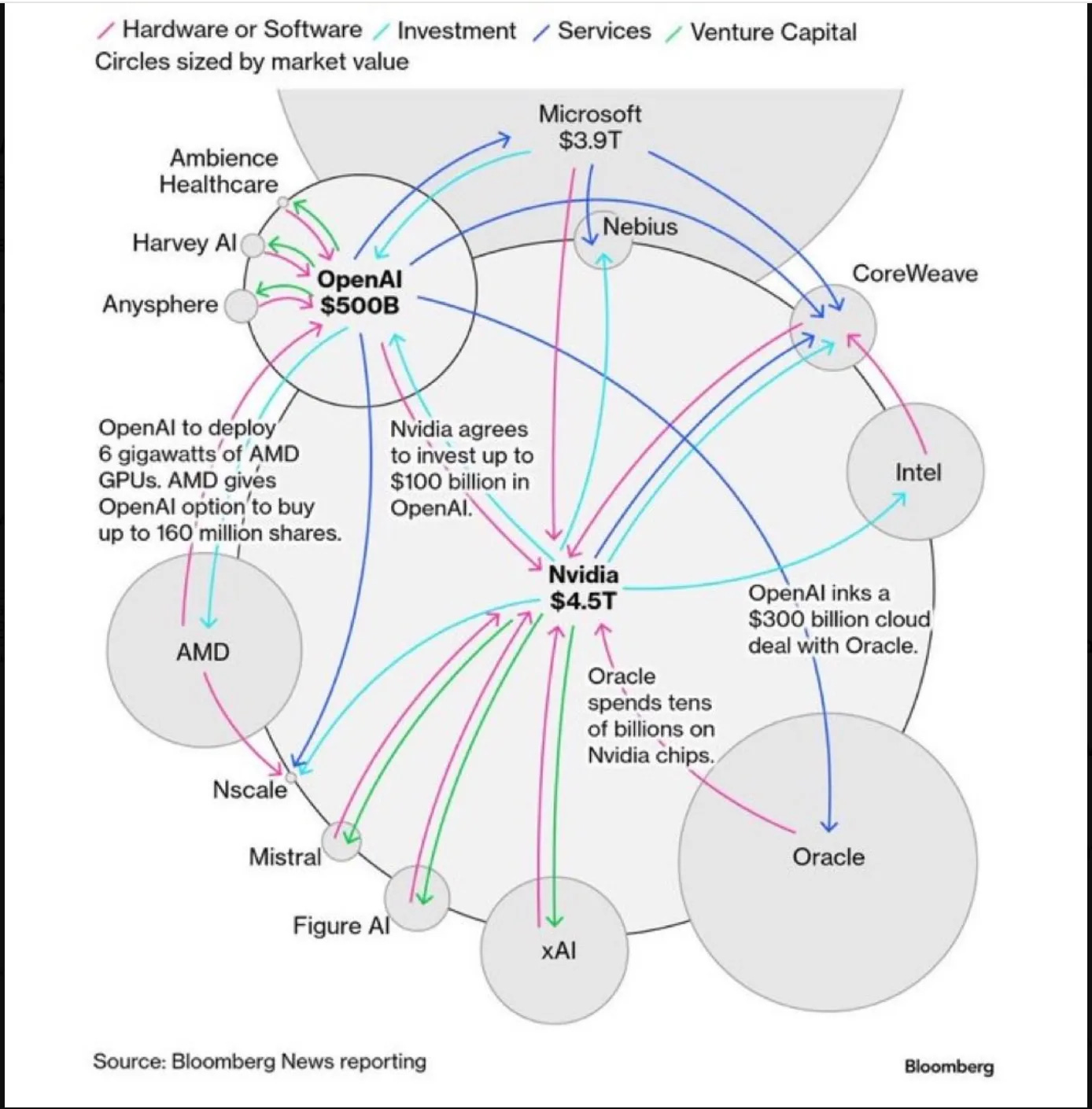
Market Concentration Metrics:
NVIDIA: 16% of nominal GDP (vs. Cisco’s 4% peak in 2000)
Magnificent Seven: 33% of S&P 500 market cap
AI infrastructure proposals: $1.4 trillion in planned data centers
OpenAI economics: $12B revenue projection against hundreds of billions deployed
The Monopolization Thesis
History shows us that transformative technologies follow a predictable path: capital-intensive growth phases funded by speculation, followed by consolidation where winners achieve profitability through market dominance. Amazon, Meta, and Uber all burned capital until reaching monopolistic positions.
The AI sector appears to be following this playbook at hyperspeed. The question isn’t whether AI will transform industries—it will. The question is whether current valuations reflect the timeline to profitability.
Three Structural Constraints
1. Resource Limitations Data centers consume massive quantities of freshwater and electricity. Communities absorb these infrastructure costs while benefits accrue to shareholders. This socializes costs while privatizing gains—historically an unsustainable arrangement.
2. Technical Requirements AI systems require three non-negotiable inputs: computational objectives, well-defined parameters, and massive clean datasets. The challenge isn’t the technology—it’s that profitable applications must justify trillion-dollar infrastructure investments.
3. Profitability Timeline The path to profitability requires either monopolistic pricing power or ubiquitous adoption. Both scenarios require time horizons that may exceed current capital structures.
Why Hedging Makes Sense
Deutsche’s reported strategy—synthetic risk transfers and equity shorts against long data center positions—represents sophisticated portfolio management, not market pessimism. They’re maintaining exposure to AI growth while protecting against concentration risk.
Consider the precedent: In 2008, profitable trades weren’t about predicting collapse—they were about recognizing when risk/reward had become asymmetric. Michael Burry made $100M. John Paulson made $20B. The difference? Position sizing when insurance was cheap.
The Macro Question
With AI spending driving one-third of S&P 500 valuations and becoming the primary U.S. economic growth engine, concentration risk isn’t just a portfolio concern—it’s systemic.
Smart institutions don’t wait for certainty. They position when asymmetry emerges.
The lesson from 2008 wasn’t that bubbles burst—it’s that those who recognized concentration risk early could maintain upside participation while protecting downside.
Deutsche Bank appears to be taking notes from their own playbook. Perhaps we should too.
The Anti-Fragile Alternative: Where We’re Building
While trillion-dollar data centers chase diminishing returns, we’re building and investing in technologies that thrive regardless of macro conditions:
Blockchain Infrastructure: The Efficiency Play
RWA Tokenization: Converting real-world assets to blockchain reduces settlement from T+2 to seconds, eliminating billions in trapped capital
Private Payment Rails: Zero-knowledge proof systems enabling compliant yet private transactions—essential as CBDCs and surveillance capitalism expand
These systems run on existing infrastructure, no new data centers required
Nuclear Renaissance: The Energy Arbitrage
SMRs (Small Modular Reactors) solve AI’s actual bottleneck: sustainable power
While others compete for grid capacity, nuclear provides dedicated baseload
The beauty? Whether AI booms or busts, the world needs clean, reliable energy
Targeted AI Implementation: The Surgical Approach
Workstream Replacement: Specific, measurable ROI on defined processes
Data Validation: Using AI to verify and clean datasets, not generate synthetic realities
Edge computing and specialized models that don’t require hyperscale infrastructure
Your data stays yours—no training competitor models
Why This Portfolio Works in Any Scenario
If AI Delivers on Promises:
Nuclear powers the revolution
Blockchain handles the massive transaction volume
Our targeted AI solutions integrate seamlessly
If Current Valuations Correct:
Energy infrastructure remains essential
Financial rails still need upgrading
Efficient workstream automation delivers immediate ROI
The difference? We’re building infrastructure that solves today’s problems while positioning for tomorrow’s opportunities. Not betting against innovation—investing in sustainable innovation.
Smart money isn’t just hedging the bubble. It’s building what comes next.
#RiskManagement #Blockchain #NuclearEnergy #AI #RWA #Tokenization #SMR #VentureCapital #MarketStructure